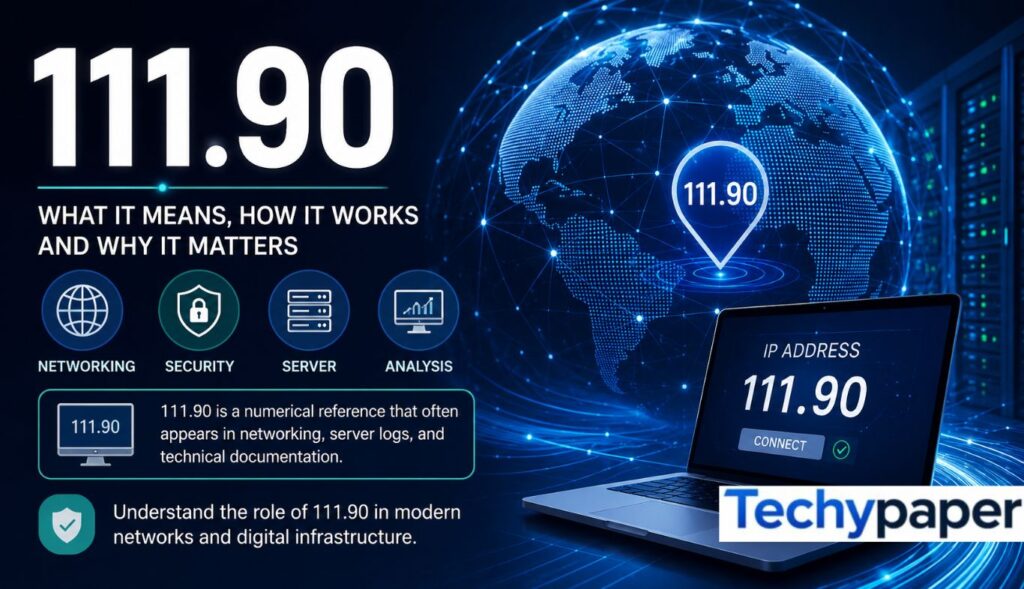

The term 111.90 may appear simple at first glance, but it can represent different things depending on the context in which it is used. Many internet users encounter 111.90 while working with networks, server configurations, IP-related information, or technical documentation. Because of its broad usage, understanding what 111.90 actually refers to is important for both beginners and experienced users.
In Indonesia, interest in networking, cybersecurity, website management, and internet infrastructure has grown rapidly over the past few years. As more businesses and individuals rely on digital services, technical terms such as 111.90 often appear during troubleshooting, website hosting, or network analysis. Knowing how these numbers are used can help users avoid confusion and make informed decisions.
Although 111.90 might resemble part of an IP address, it should never be interpreted without considering the complete context. Network addresses, server identifiers, and routing information all require accurate interpretation. This guide explains the different possibilities associated with 111.90, how it may be used, and why understanding networking basics can improve your digital knowledge.
Whether you are a student, website owner, IT professional, or simply curious about networking terminology, this article provides practical explanations in clear language. By the end, you will understand the significance of 111.90, how similar numerical values appear in networking environments, and what best practices should always be followed.
Understanding What 111.90 Means
The value 111.90 is commonly recognised as a numerical identifier that may appear within technical documentation, networking examples, server configurations, or educational materials. By itself, however, it does not represent a complete Internet Protocol address because IPv4 addresses consist of four numerical sections separated by periods. Therefore, 111.90 should usually be viewed as part of a larger address or a shortened reference used for discussion.
Technical professionals frequently work with abbreviated values while explaining networking concepts. In these situations, numbers such as 111.90 help demonstrate addressing schemes without revealing complete server information. This approach improves privacy while still allowing educational discussions about networking technologies.
Understanding the context is essential because identical numerical values may have different meanings in different systems. A server administrator may interpret 111.90 differently from a cybersecurity analyst or a website developer. Rather than assuming a single meaning, users should examine the surrounding information before drawing conclusions.
As digital infrastructure continues expanding across Indonesia, awareness of networking terminology has become increasingly valuable. Universities, businesses, and technology organisations regularly introduce these concepts during IT training, making it useful for readers to understand how values like 111.90 fit into broader networking principles.
Why 111.90 Appears in Networking
Modern internet communication depends on structured addressing systems that allow billions of devices to exchange information efficiently. Within these systems, numbers similar to 111.90 often appear during configuration, monitoring, diagnostics, and server management.
When network engineers analyse traffic, they frequently examine address ranges rather than individual devices. This makes shortened references practical during discussions or documentation. Instead of displaying an entire address repeatedly, partial identifiers may be used when the remaining portions are either unnecessary or intentionally hidden.
Website administrators also encounter similar values while reviewing hosting logs, firewall reports, DNS records, and network monitoring dashboards. Although the exact meaning depends on the software being used, recognising these numerical references helps professionals investigate connectivity issues more effectively.
Indonesia’s growing digital economy has increased demand for skilled IT professionals capable of understanding networking terminology. From cloud hosting to enterprise infrastructure, familiarity with address structures contributes to smoother troubleshooting and better communication between technical teams.
Is 111.90 an IP Address?
One of the most common questions surrounding 111.90 concerns whether it qualifies as an actual IP address. The simple answer is that 111.90 alone is not a complete IPv4 address.
An IPv4 address contains four numerical groups separated by three periods. Each section contains values ranging from zero to 255. For example, a valid IPv4 address follows the familiar structure of four complete numerical segments. Since 111.90 contains only two segments, additional information would be required before identifying a specific device on the internet.

Despite this limitation, partial address references remain common within technical documentation. Engineers sometimes display only selected portions of an address when discussing routing behaviour, subnet planning, server clusters, or educational examples. This protects sensitive infrastructure information while still illustrating important networking concepts.
It is also possible that 111.90 appears in internal documentation unrelated to IP addressing altogether. Database identifiers, configuration files, application logs, and monitoring systems sometimes use numerical references that resemble network addresses even though they serve entirely different purposes.
Understanding this distinction prevents unnecessary confusion and helps users interpret technical information more accurately.
Common Uses of 111.90 in Technical Environments
Within professional IT environments, values similar to 111.90 may appear across numerous systems. Server administrators often review partial numerical references while analysing system logs generated by web servers, security appliances, or monitoring software.
Software developers may encounter similar identifiers while testing applications connected to cloud infrastructure. Development environments frequently mask sensitive information, replacing complete addresses with shortened representations. This protects production systems while allowing developers to verify application functionality.
Educational institutions also rely on simplified networking examples when teaching students about IP addressing, subnetting, DNS resolution, and routing protocols. Using abbreviated references enables instructors to focus on networking concepts rather than exposing operational infrastructure.
Cybersecurity professionals analyse enormous volumes of network traffic every day. During incident investigations, numerical references may appear within threat intelligence reports, firewall logs, intrusion detection systems, and malware analysis platforms. Understanding how these references relate to networking improves investigation efficiency and reduces the likelihood of incorrect conclusions.
As organisations throughout Indonesia continue adopting cloud computing, digital transformation, and online business services, knowledge of networking terminology becomes increasingly valuable across industries, not just within dedicated IT departments.
Internet Infrastructure and the Role of 111.90
Internet infrastructure is built upon a collection of interconnected networks that exchange information every second. Every website, email service, cloud application, and online platform depends on reliable addressing systems to ensure data reaches the correct destination. Although 111.90 is not a complete IP address by itself, values like it often appear when administrators analyse network ranges, monitor traffic, or review technical reports.
When a user in Indonesia opens a website, the request travels through several routers and internet service providers before reaching the hosting server. During this journey, multiple addressing systems work together to identify where the request originated and where it should be delivered. Network engineers frequently examine portions of addresses while diagnosing delays or routing problems, making references similar to 111.90 common within technical documentation.
Cloud computing has further increased the importance of understanding network identifiers. Many businesses now operate applications across several data centres, requiring administrators to monitor thousands of connections simultaneously. Instead of displaying every complete address repeatedly, management software sometimes groups systems according to shared address ranges. As a result, abbreviated references help simplify large-scale network management without exposing sensitive infrastructure details.
Reliable internet infrastructure also depends on accurate routing information. Routers exchange data continuously to determine the fastest and safest path for information. Even a small configuration mistake can affect website accessibility or application performance. Therefore, professionals regularly review logs containing numerical references similar to 111.90 while verifying that network routes operate correctly.
Indonesia’s expanding digital economy has encouraged organisations to invest heavily in secure and efficient networking technologies. Businesses, educational institutions, and government agencies all rely on stable internet connectivity, making a basic understanding of networking terminology increasingly valuable for professionals in many industries.
How Network Administrators Interpret Values Like 111.90
Experienced network administrators rarely evaluate a numerical value without considering the surrounding context. A sequence such as 111.90 might appear within firewall reports, DNS records, server monitoring dashboards, or system configuration files. Each environment assigns different meaning to the same numbers, demonstrating why context is essential.
When troubleshooting connectivity issues, administrators first determine whether the value represents an IP range, subnet information, log reference, or application identifier. They compare it with other network information before making configuration changes. This careful approach reduces errors and prevents unnecessary service interruptions.
Monitoring software also generates reports that include shortened address references. Large organisations often manage thousands of connected devices, making full address listings difficult to analyse quickly. By grouping similar values, administrators can identify trends, unusual traffic patterns, or performance issues more efficiently.
Documentation practices vary between organisations as well. Some companies intentionally hide portions of server addresses before sharing reports internally or with external consultants. This protects infrastructure while still allowing technical discussions. Consequently, encountering a partial value such as 111.90 should not immediately lead users to assume it represents a complete internet address.
The Relationship Between 111.90 and Website Hosting
Website hosting relies on precise networking to deliver web pages to visitors around the world. Every hosting server has one or more IP addresses that allow browsers to locate website files. Although 111.90 alone cannot identify a hosting server, similar numerical references often appear during server administration and hosting management.
Hosting providers monitor network performance continuously to ensure websites remain available. Their systems record connection attempts, server response times, and traffic statistics using detailed network logs. Administrators reviewing these reports may encounter abbreviated numerical values while investigating performance or security events.
Domain Name System services also play a significant role. Instead of remembering complex numerical addresses, users type domain names into their browsers. DNS servers then translate those names into the correct IP addresses. During DNS troubleshooting, partial numerical references may appear in diagnostic reports, helping engineers verify whether domain records point to the correct destination.
Businesses operating e-commerce stores or company websites benefit from understanding these fundamentals. Even if website owners never configure servers themselves, recognising networking terminology enables more effective communication with hosting providers and technical support teams.
Cybersecurity and Safe Handling of Network Information
Cybersecurity has become one of the most important aspects of modern digital infrastructure. Every organisation connected to the internet faces potential threats ranging from automated scanning attempts to sophisticated cyberattacks. Understanding references such as 111.90 contributes to better security awareness because network identifiers often appear in firewall logs, intrusion detection systems, and security monitoring tools.
Security professionals examine network traffic continuously to identify unusual behaviour. Suspicious activity may include repeated login attempts, unexpected connection requests, or abnormal data transfers. Log files frequently contain numerical references that help analysts determine where traffic originated and how it moved through the network.
However, it is important not to draw conclusions based solely on a partial numerical value. Effective cybersecurity requires analysing complete information, including timestamps, protocols, destination systems, and user activity. A value like 111.90 only becomes meaningful when interpreted within the broader context of network events.
Organisations should also avoid publishing complete infrastructure details unnecessarily. Limiting the exposure of sensitive network information reduces opportunities for malicious actors to gather intelligence about internal systems. Many technical documents intentionally abbreviate addresses for this reason, balancing educational value with responsible security practices.
Common Misunderstandings About 111.90
Many people assume that every number containing periods automatically represents an internet address. While this assumption seems reasonable, it is not always correct. 111.90 demonstrates why understanding networking standards is essential before interpreting technical information.
Another common misunderstanding involves attempting to identify the location of a server using only a partial value. Since a complete IP address contains four numerical sections, geographic identification is impossible using only two segments. Additional information would always be required before determining the associated network.

Some users also believe that any unfamiliar numerical reference indicates suspicious activity. In reality, system logs contain countless identifiers generated during normal operations. Network monitoring software, server management platforms, and application logs produce numerical references continuously without indicating security problems.
Educational resources often simplify technical examples by shortening addresses. This helps readers focus on networking concepts without exposing production systems. Consequently, readers should treat values such as 111.90 as learning examples unless accompanied by complete technical documentation.
Why Networking Knowledge Matters in Indonesia
Indonesia continues to experience rapid growth in internet adoption, digital commerce, cloud computing, and online education. Millions of people now depend on reliable internet services for work, communication, entertainment, and business operations. As digital transformation accelerates, networking literacy becomes increasingly valuable.
Students studying information technology benefit from understanding how addressing systems function because these concepts form the foundation of networking education. Likewise, entrepreneurs operating online businesses gain practical advantages by understanding basic server terminology when communicating with hosting providers or developers.
Government agencies and private organisations are also investing heavily in cybersecurity and digital infrastructure. This creates demand for professionals capable of interpreting technical documentation accurately and solving networking challenges efficiently. Learning about concepts associated with values like 111.90 provides a useful starting point for anyone interested in technology.
Even non-technical users benefit from greater awareness. Understanding the difference between complete IP addresses, abbreviated references, and other numerical identifiers reduces confusion when reading technical articles or troubleshooting internet-related issues.
Best Practices for Working with Network Information
Anyone working with networking information should prioritise accuracy and verification. Before interpreting a value such as 111.90, it is important to determine where it originated and what purpose it serves within the relevant system. Careful analysis prevents misunderstandings and improves troubleshooting efficiency.
Maintaining updated documentation also contributes to successful network management. Clear records allow administrators to identify infrastructure changes, review previous configurations, and resolve problems more quickly. Consistent documentation becomes increasingly valuable as organisations expand their digital environments.
Security should remain a priority throughout every stage of network administration. Sensitive infrastructure information should only be shared with authorised personnel, while publicly available educational materials should avoid exposing operational server details unnecessarily. This balance supports both knowledge sharing and responsible cybersecurity.
Continuous learning is equally important because networking technologies evolve rapidly. Cloud services, virtual networking, IPv6 adoption, and advanced security solutions continue changing the way organisations manage digital infrastructure. Staying informed enables professionals to adapt confidently to new technologies and industry standards.
Finally, users should remember that 111.90 alone does not provide sufficient information to identify a server, diagnose a network issue, or determine security status. Effective analysis always depends on complete context, accurate documentation, and sound technical understanding.
Frequently Asked Questions
What does 111.90 mean in networking?
The term 111.90 is generally a partial numerical value that may appear in networking discussions, technical documentation, or server logs. On its own, it is not a complete IPv4 address because a valid IPv4 address consists of four numerical sections separated by periods. Its meaning depends entirely on the context in which it appears. In many cases, professionals use abbreviated values when explaining networking concepts or protecting sensitive infrastructure details. Understanding the surrounding information is essential before assigning any specific meaning to 111.90.
Is 111.90 a valid IP address?
No, 111.90 is not a valid standalone IPv4 address. A complete IPv4 address contains four octets, such as 192.168.1.1, with each section ranging from 0 to 255. Since 111.90 contains only two numerical segments, it cannot uniquely identify a device on the internet. However, it may represent part of a larger address, an internal reference, or a shortened notation used in technical documents or educational materials.
Why do I see 111.90 in server logs or technical documents?
You may encounter 111.90 in server logs, monitoring tools, firewall reports, or educational resources because administrators often use shortened references to simplify technical information or protect sensitive network details. Instead of displaying complete addresses, documentation may show only part of the information. This approach allows engineers and learners to understand networking concepts while maintaining privacy and reducing unnecessary exposure of production systems.
Can 111.90 help identify a website or server?
By itself, 111.90 cannot identify a specific website, hosting provider, or server. Accurate identification requires a complete IP address or additional technical information. Many servers share similar address ranges, and partial values are insufficient for precise identification. Network professionals rely on complete addressing data, DNS records, routing information, and server configurations before determining where a website or service is hosted.
Is 111.90 related to cybersecurity?
In some situations, 111.90 may appear in cybersecurity investigations because security analysts frequently examine network logs containing numerical references. However, the value alone does not indicate malicious activity. Cybersecurity professionals analyse complete traffic records, timestamps, connection details, and other contextual information before determining whether any security threat exists. Partial numerical values should never be interpreted as evidence of an attack without supporting information.
How can beginners learn more about networking concepts like 111.90?
Beginners should start by learning the fundamentals of IP addressing, Domain Name System (DNS), routers, subnets, and internet communication. Understanding how devices connect across networks makes it much easier to interpret values such as 111.90. Reading networking guides, taking online courses, and practising with virtual lab environments provide practical experience while building confidence in understanding technical documentation and network configurations.
Why is understanding 111.90 useful for website owners?
Website owners often communicate with hosting companies, developers, and technical support teams regarding server performance, website security, or DNS configuration. Although 111.90 itself may not represent a complete address, recognising similar networking references helps website owners understand technical discussions more effectively. This knowledge supports better decision-making, smoother troubleshooting, and more productive communication with IT professionals.
Conclusion
Understanding 111.90 begins with recognising that context is everything. While 111.90 may resemble part of an IP address, it is not a complete IPv4 address and should never be interpreted in isolation. Instead, it commonly appears as a partial reference within networking documentation, server logs, educational resources, or technical discussions.
As Indonesia’s digital landscape continues to grow, networking knowledge has become increasingly valuable for students, professionals, businesses, and website owners alike. Learning how addressing systems, DNS services, hosting environments, and cybersecurity practices work together provides a stronger foundation for navigating today’s internet-driven world. Even a seemingly simple value like 111.90 can become meaningful when viewed within the correct technical context.

Ultimately, 111.90 serves as an excellent reminder that accurate analysis depends on complete information rather than assumptions. By understanding networking basics, following responsible security practices, and continuing to build technical knowledge, readers can confidently interpret similar references in the future. Whether you manage websites, study information technology, or simply want to expand your digital skills, developing a clear understanding of 111.90 and related networking concepts will help you make better-informed decisions in an increasingly connected world.