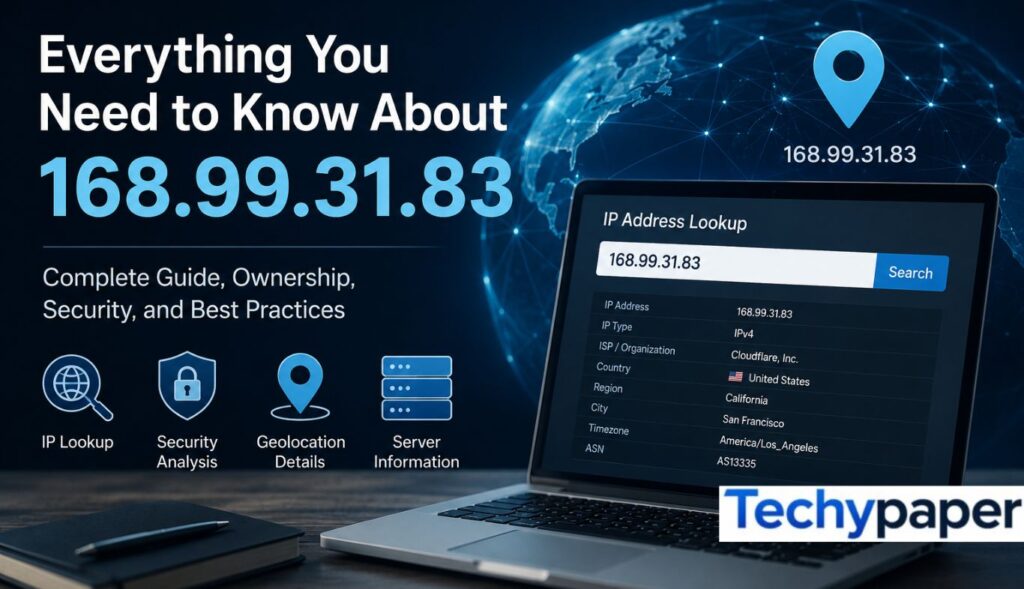

Every device connected to the internet communicates through an Internet Protocol (IP) address. One such address that often appears in network logs, server records, and online lookup tools is 168.99.31.83. While many users search for this IP address out of curiosity, others encounter it while managing websites, monitoring traffic, or troubleshooting technical issues.
Understanding what 168.99.31.83 represents can help individuals, website owners, and IT professionals make informed decisions. An IP address itself does not automatically indicate a security threat, a trusted source, or a specific organization. Instead, it serves as a unique identifier that allows internet-connected devices to communicate efficiently across networks.
For users in Indonesia and around the world, learning about IP addresses such as 168.99.31.83 is increasingly important because cybersecurity, cloud hosting, and digital services continue to expand rapidly. Whether you are investigating website traffic, checking server ownership, or simply trying to understand how internet infrastructure works, having accurate information is essential.
This guide explains 168.99.31.83 in simple language while also providing technical insights for readers who want a deeper understanding. By the end of this article, you will know how IP addresses function, why they matter, and how to evaluate an IP address responsibly without making incorrect assumptions.
What Is 168.99.31.83?
The address 168.99.31.83 is a public IPv4 address. IPv4 addresses consist of four groups of numbers separated by periods, making them easy for networking equipment to identify and route internet traffic. Every public IP address exists within a global allocation system that ensures uniqueness across the internet.
When someone searches for 168.99.31.83, they are often attempting to identify where the address originates, which organization manages it, or whether it is associated with a particular website or online service. These searches are common among network administrators, cybersecurity professionals, developers, and website owners.
It is important to understand that a public IP address alone does not reveal personal information. Instead, it typically points toward a server, hosting provider, business network, or internet service infrastructure. Responsible interpretation of IP information requires combining several sources rather than relying solely on the address itself.
Another key point is that public IP addresses can change ownership over time. Organizations may transfer address ranges, migrate servers, or reconfigure infrastructure, meaning historical information may no longer be accurate.
Read More: OnlyWorkMoods com Review: Is It Legit, Safe, and Worth Your Time? Guide 2026
Understanding IP Addresses
Every device connected to the internet requires an address to send and receive information. Just as homes have postal addresses for receiving mail, computers and servers rely on IP addresses for communication.
An IP address enables routers across the internet to determine where information should travel. Without this system, websites, email services, online games, streaming platforms, and cloud applications would not function properly.
The address 168.99.31.83 belongs to the IPv4 addressing format, which remains the most widely recognized version despite the gradual adoption of IPv6. IPv4 has served as the backbone of the internet for decades because of its simplicity and compatibility.
Whenever a user opens a website, sends an email, watches a video, or downloads a file, multiple IP addresses communicate behind the scenes to complete the request. Although these exchanges occur in milliseconds, they represent the fundamental process that powers the modern internet.
Because internet traffic continues to grow, organizations carefully manage available IPv4 addresses while gradually implementing IPv6 to support future expansion.
See More: WallPostMedia com Review 2026: Best Features, Pricing, Pros, Cons & How It Works
Why Do People Search for 168.99.31.83?
There are many legitimate reasons why someone may look up 168.99.31.83. Website owners often review visitor logs and notice unfamiliar IP addresses. Security teams investigate unusual activity to determine whether connections are legitimate. Developers may also inspect server logs while troubleshooting application performance.
Another common reason involves domain hosting research. Many websites share servers with hundreds or even thousands of other domains. Looking up an IP address helps administrators understand where a website is hosted and how network resources are organized.
Some users simply encounter 168.99.31.83 during internet browsing or firewall reports and want to learn whether it represents a trusted server. While curiosity is understandable, it is important not to assume an IP address is malicious simply because it appears unfamiliar.

Educational purposes also drive many searches. Students studying networking frequently investigate real-world IP addresses to better understand DNS records, hosting infrastructure, and internet routing. Examining examples like 168.99.31.83 helps explain theoretical networking concepts through practical observation.
As cybersecurity awareness increases in Indonesia, more individuals are becoming interested in learning how internet infrastructure functions. Understanding public IP addresses contributes to stronger digital literacy and safer online practices.
See More: Snapjotz com: What Is Snapjotz and How Does It Work?
How Public IP Addresses Work
A public IP address allows devices to communicate across the global internet. Unlike private IP addresses used within homes or offices, public addresses are reachable from external networks and are assigned according to international allocation policies.
When someone enters a website address into a browser, the domain name system translates the website name into a numerical IP address. The browser then connects to the appropriate server using that address.
This process occurs automatically and usually takes only fractions of a second. Although users rarely notice these technical operations, they form the basis of every online interaction.
The address 168.99.31.83 may represent a physical server, a virtual private server, a cloud instance, or other internet-connected infrastructure. Modern hosting providers frequently assign public IP addresses to cloud resources, making them accessible worldwide.
Because businesses increasingly rely on cloud technology, a single IP address may support multiple applications, websites, databases, or web services simultaneously. This flexibility allows organizations to scale efficiently while maintaining reliable internet connectivity.
Common Uses of Public IP Addresses
Public IP addresses perform many essential functions across today’s internet ecosystem. Web hosting companies assign them to websites so visitors can access online content from anywhere in the world. Email providers depend on public IP addresses to exchange messages between servers securely and efficiently.
Cloud computing platforms also rely heavily on public IP addresses. Virtual machines, storage services, application servers, and enterprise software often communicate through publicly accessible network endpoints.
Streaming platforms, gaming services, online education portals, and e-commerce websites all depend on public IP infrastructure to deliver reliable experiences to users. Behind every online transaction, IP addresses quietly direct information between systems.
Businesses additionally use public IP addresses to host APIs, enable remote work, support secure VPN connections, and provide access to customer portals. As digital transformation continues across Indonesia, understanding these technologies becomes increasingly valuable for companies and individuals alike.
See More: Troozer.com: A Practical Guide for First Time Visitors
Server Hosting and Cloud Infrastructure
One of the most common reasons an IP address such as 168.99.31.83 attracts attention is its connection to server hosting. Every website, application, or online service must be hosted on a server that can receive and respond to internet requests. That server is typically assigned one or more public IP addresses, allowing users from anywhere in the world to establish a connection.
Modern hosting environments differ significantly from traditional physical servers. Instead of relying on a single machine in one location, many businesses use cloud infrastructure where resources are distributed across multiple data centres. This approach improves reliability, performance, and scalability while allowing organisations to adapt to changing traffic demands. An IP address like 168.99.31.83 may therefore represent a cloud-based resource rather than a single dedicated computer.
Cloud providers frequently reassign IP addresses as virtual machines are created, updated, or removed. Because of this, information about an IP address can evolve over time. A server that hosted one website several months ago may now be supporting an entirely different application. This dynamic nature makes it important to verify current information whenever researching an IP address.
For website owners in Indonesia, understanding hosting infrastructure helps improve website performance and security. Choosing reliable hosting, monitoring server health, and maintaining updated software all contribute to a better online experience for visitors.
Understanding IP Geolocation
Many people assume an IP address reveals an exact physical location, but this is not how geolocation works. IP geolocation estimates a general region based on registration records, network routing information, and data collected by specialised databases. These estimates are useful but should never be treated as precise geographical coordinates.
When users search for 168.99.31.83, they may discover information suggesting a particular country, city, or internet provider. However, these results often represent the location of the network operator or data centre rather than the actual user or business behind the connection.
Geolocation services constantly update their databases to reflect network changes, yet differences between providers remain common. One database may associate an IP address with one location while another reports a nearby city or even a different region. These variations demonstrate why multiple sources should be consulted before drawing conclusions.
Businesses use IP geolocation for many legitimate purposes, including language selection, fraud prevention, content delivery optimisation, and regional analytics. E-commerce platforms may display local currencies, while streaming services can provide region-specific content based on approximate IP location.
Reverse DNS and Domain Associations
Another useful aspect of IP research involves reverse Domain Name System (DNS) records. Reverse DNS allows administrators to determine whether an IP address is linked to a specific hostname. While not every IP address has a configured reverse DNS record, those that do can provide additional context regarding server usage.
If 168.99.31.83 has an associated hostname, it may indicate whether the address belongs to a hosting provider, corporate server, email infrastructure, or another network service. However, reverse DNS information should always be interpreted carefully because hostnames may not accurately describe current server functions.
Many websites also share a single IP address through virtual hosting technology. This means that several unrelated domains can operate from the same server without interfering with one another. Consequently, identifying one website associated with an IP address does not necessarily reveal every service using that infrastructure.
Understanding these technical relationships helps administrators troubleshoot connectivity issues while improving network management practices.
Security Considerations When Investigating 168.99.31.83
Cybersecurity has become increasingly important as businesses and individuals spend more time online. Encountering an unfamiliar IP address can naturally raise questions, but caution should be exercised before assuming malicious intent.
An address such as 168.99.31.83 may simply represent a legitimate server performing routine internet functions. Search engine crawlers, content delivery networks, cloud applications, monitoring services, and automated backup systems all generate network traffic that appears in server logs.
Security professionals typically evaluate IP addresses using multiple indicators rather than relying on the address alone. They consider network behaviour, connection frequency, authentication attempts, firewall logs, and threat intelligence databases before determining whether activity is suspicious.
For example, repeated failed login attempts from the same IP address may warrant further investigation. On the other hand, occasional visits from cloud-hosted servers or search engine bots are often perfectly normal. Context is therefore essential when analysing network traffic.
Organisations should also implement strong cybersecurity measures such as multi-factor authentication, regular software updates, secure password policies, and properly configured firewalls. These practices reduce overall risk regardless of which IP addresses interact with a system.
Can an IP Address Identify an Individual?
A common misconception is that a public IP address immediately identifies a specific person. In reality, an IP address generally identifies an internet connection rather than an individual user.
Many households share a single public IP address among multiple devices through network address translation. Similarly, businesses often have hundreds of employees using one internet connection, making it impossible to determine which individual performed a particular action based solely on the public IP address.
Internet service providers maintain customer assignment records, but these records are protected by privacy laws and are not publicly available. Access usually requires appropriate legal procedures or authorised investigations.
This distinction is important because making assumptions about identity based only on an IP address can lead to inaccurate conclusions.
Best Practices for Responsible IP Research
Researching 168.99.31.83 should always be approached responsibly. Reliable information comes from reputable networking tools, security platforms, and recognised internet registries rather than rumours or unverified online discussions.
Cross-checking multiple sources helps reduce errors because IP ownership, hosting arrangements, and routing information may change over time. Verifying information through several databases provides a more complete understanding of the address being investigated.
Website administrators should maintain detailed server logs while respecting user privacy and applicable data protection regulations. Keeping accurate records allows organisations to investigate technical issues without compromising ethical standards.

It is equally important to distinguish between curiosity and evidence. Simply appearing in a server log does not indicate malicious behaviour. Network analysis requires context, careful observation, and professional judgement.
The Importance of Network Monitoring
Continuous network monitoring enables organisations to detect unusual activity before it develops into serious security incidents. Monitoring tools analyse traffic patterns, server performance, and connection attempts in real time, helping administrators respond quickly when anomalies appear.
If 168.99.31.83 repeatedly appears in connection logs, administrators can review associated timestamps, request types, response codes, and authentication records to determine whether activity is expected. This method provides far more reliable insight than focusing on the IP address alone.
Regular monitoring also improves website availability by identifying performance bottlenecks, hardware failures, and configuration problems before users experience disruptions. As online services continue to grow throughout Indonesia, proactive network management remains an essential part of digital success.
Frequently Asked Questions
What is 168.99.31.83?
168.99.31.83 is a public IPv4 address that can be assigned to a server, cloud instance, hosting provider, or another internet-connected device. Like every public IP address, it serves as a unique identifier that enables devices to communicate across the internet. The address itself does not automatically reveal whether it belongs to a particular company, website, or individual, as ownership and usage can change over time depending on network allocation.
Is 168.99.31.83 dangerous?
No conclusion can be made simply by looking at the IP address. 168.99.31.83 is not inherently safe or dangerous. An IP address is only a technical identifier, and its reputation depends on how it is being used at a particular time. Security professionals evaluate network behaviour, connection history, firewall logs, and other technical indicators before determining whether activity associated with an IP address should be considered suspicious.
Can I find the exact location of 168.99.31.83?
Not with complete accuracy. IP geolocation services provide an estimated location based on available network registration data and routing information. The reported country or city often represents the location of a data centre, internet provider, or network operator rather than the exact physical location of the server or user. Because databases differ, geolocation results may vary between providers.
Why does 168.99.31.83 appear in my website logs?
Website logs record every connection made to a server. If 168.99.31.83 appears in your logs, it may simply indicate that a visitor, automated service, monitoring tool, search engine crawler, or cloud-based application accessed your website. Its presence alone does not indicate malicious activity. Reviewing request details and traffic patterns provides a more accurate understanding of the connection.
Can one IP address host multiple websites?
Yes. Modern web hosting commonly uses virtual hosting technology, allowing many different websites to share the same public IP address. This approach helps hosting providers manage resources efficiently while reducing costs. Therefore, discovering that 168.99.31.83 is associated with one domain does not necessarily mean it hosts only that website.
How can businesses use information about 168.99.31.83 responsibly?
Businesses can use information about 168.99.31.83 for network troubleshooting, cybersecurity monitoring, server management, and website performance analysis. Responsible use includes verifying information through trusted sources, respecting privacy regulations, and avoiding assumptions based solely on an IP address. Proper network analysis always considers additional technical evidence before reaching conclusions.
Why is understanding IP addresses important?
Understanding IP addresses such as 168.99.31.83 helps individuals and organisations better understand how the internet functions. Knowledge of IP addressing supports website management, cybersecurity awareness, network troubleshooting, and cloud infrastructure planning. As digital services continue to expand in Indonesia, this knowledge becomes increasingly valuable for businesses, students, developers, and everyday internet users.
Conclusion
The public IP address 168.99.31.83 represents one small but essential part of the internet’s global infrastructure. Although many people search for 168.99.31.83 to identify its purpose or ownership, it is important to remember that an IP address alone does not provide complete information about a server, organisation, or online activity.
Throughout this guide, we explored how public IP addresses function, why they appear in website logs, how hosting providers and cloud services use them, and why geolocation data should always be interpreted carefully. We also discussed the importance of cybersecurity, responsible network analysis, and ongoing monitoring to ensure reliable and secure internet operations.
For website owners, developers, and internet users in Indonesia, understanding 168.99.31.83 contributes to stronger digital literacy and more informed decision-making. Rather than relying on assumptions, always verify information using trusted networking resources and evaluate IP addresses within their broader technical context.

As internet technologies continue to evolve, public IP addresses like 168.99.31.83 will remain fundamental to global communication. By learning how they work and applying best practices for security and research, you can confidently manage online resources, protect your digital assets, and make smarter technology decisions in an increasingly connected world.