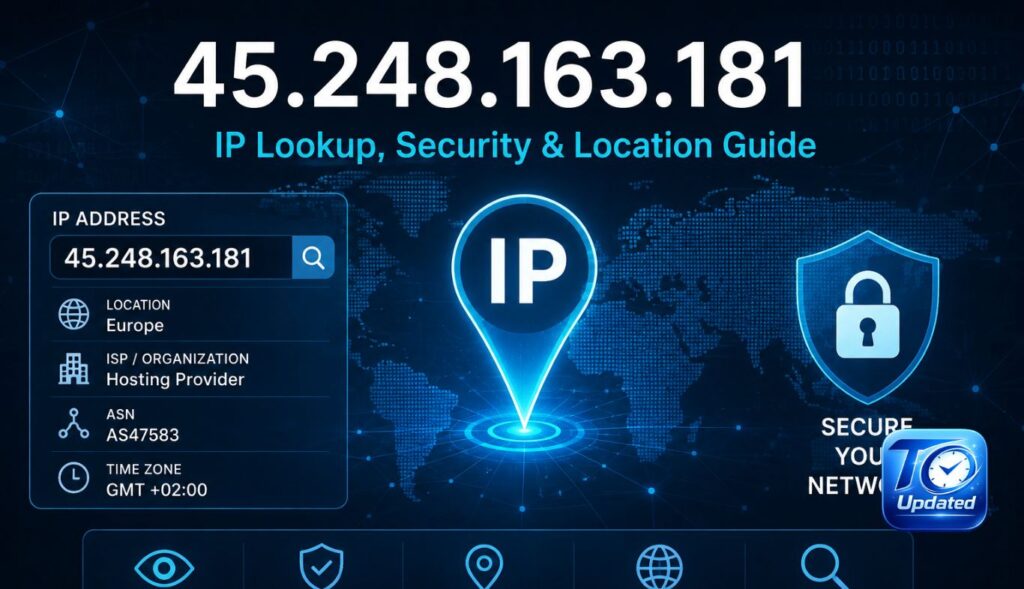

Every device connected to the internet communicates through an Internet Protocol (IP) address. One such address that may appear in network logs, security reports, or server analytics is 45.248.163.181. Whether you are an IT professional, website owner, cybersecurity enthusiast, or simply curious, understanding what an IP address represents can help you make informed decisions.
When people search for 45.248.163.181, they are often trying to determine who owns the IP, where it is located, whether it is safe, or why it appears in their network activity. While an IP address alone cannot reveal the identity of a specific individual, it can provide useful technical information about the network responsible for that address.
Learning how IP addresses work also improves your understanding of internet security. It becomes easier to recognize suspicious traffic, investigate login attempts, and verify whether a connection comes from a trusted network.
This guide explores 45.248.163.181 in detail, explaining what it is, how IP lookups work, what information is publicly available, and how to safely analyze any IP address without violating privacy or relying on inaccurate assumptions.
Understanding 45.248.163.181
What Does 45.248.163.181 Represent?
The address 45.248.163.181 is an IPv4 address. IPv4 remains the most widely used version of the Internet Protocol despite the growing adoption of IPv6. Every public IPv4 address serves as a unique identifier that enables devices to communicate over the internet.
When users search for 45.248.163.181, they are generally interested in discovering technical details such as the hosting provider, country, autonomous system (ASN), or possible network owner. These details are publicly available through internet registry databases and IP intelligence services.
However, it is important to understand that an IP address does not automatically identify a person. Instead, it usually identifies the internet service provider, cloud hosting company, or organization responsible for managing that address range.
Why People Search for 45.248.163.181
There are several legitimate reasons someone might investigate 45.248.163.181.
Website administrators often review server logs after noticing repeated login attempts or unusual traffic. Security professionals analyze unfamiliar IP addresses while investigating suspicious activity. Network engineers verify routing information to troubleshoot connectivity issues. Digital marketers sometimes examine visitor locations to better understand website traffic patterns.
In every case, the goal is to gather technical information rather than personal information.
What Is an IPv4 Address?
IPv4 stands for Internet Protocol Version 4. It uses a 32-bit addressing system that creates over four billion unique addresses. Every IPv4 address consists of four numerical sections separated by periods.
The address 45.248.163.181 follows this standard format perfectly. Each section contains a value ranging from 0 to 255, allowing computers and networking equipment to recognize and route internet traffic correctly.
Although IPv6 was introduced to overcome IPv4 address exhaustion, IPv4 continues to dominate internet infrastructure because of its widespread compatibility and long-established deployment.

Most businesses, cloud platforms, hosting companies, and internet service providers still operate extensive IPv4 networks.
Public vs. Private IP Addresses
One important distinction is the difference between public and private IP addresses.
A public IP address, such as 45.248.163.181, is accessible through the internet and can communicate with systems worldwide. These addresses are allocated through regional internet registries and managed by internet providers or hosting organizations.
Private IP addresses, on the other hand, operate only inside local networks. Addresses like 192.168.x.x or 10.x.x.x cannot be accessed directly from the public internet.
This distinction explains why public IP addresses often appear in website analytics, firewall logs, and cybersecurity investigations.
How IP Addresses Are Assigned
Internet addresses are carefully managed to prevent conflicts and ensure efficient routing.
Regional Internet Registries allocate address ranges to internet service providers, cloud companies, educational institutions, and large organizations. These organizations then distribute addresses according to operational requirements.
The address 45.248.163.181 belongs to one such allocated range. Exact ownership may change over time because organizations occasionally transfer IP blocks, merge networks, or update routing policies.
For this reason, modern IP lookup databases regularly synchronize their records to reflect the latest allocation information.
Static and Dynamic IP Addresses
Some public IP addresses remain unchanged for extended periods. These are known as static IP addresses and are commonly used for business servers, hosting services, and enterprise infrastructure.
Others are assigned dynamically through DHCP systems. Residential internet users frequently receive dynamic addresses that change periodically depending on their internet provider.
Knowing whether 45.248.163.181 is static or dynamic requires examining the network environment in which it operates.
Public Information Available About 45.248.163.181
Several categories of information can usually be discovered through publicly available IP databases.
An IP lookup generally provides the registered country, approximate geographic region, autonomous system number, routing organization, network provider, reverse DNS records if configured, and allocation history.
This information helps administrators understand where traffic originates and which organization manages the address block.
It is equally important to understand what cannot be learned from an IP address.
An IP lookup does not reveal someone’s name, exact home address, passwords, personal files, or private browsing history. Those assumptions are common misconceptions and should be avoided.
How IP Lookup Services Work
IP lookup services collect information from Regional Internet Registries, Border Gateway Protocol (BGP) routing tables, Autonomous System (AS) announcements, DNS records, and publicly available network databases. They organize this information into searchable databases that allow users to investigate addresses like 45.248.163.181.
When you enter 45.248.163.181 into an IP lookup tool, the service compares the address against its latest records and returns technical information. Depending on the provider, the results may include the network owner, internet service provider, hosting company, Autonomous System Number (ASN), approximate location, and reverse DNS hostname if one exists.
Because these databases are updated regularly, results may change over time. Organizations sometimes transfer IP address blocks, expand their networks, or migrate services to different data centers. Therefore, an IP lookup reflects the most recent publicly available information rather than permanent ownership.
Understanding WHOIS Information
WHOIS is one of the most commonly used resources for researching IP addresses. Instead of identifying an individual user, WHOIS records identify the organization responsible for managing an IP block.
For 45.248.163.181, a WHOIS search may reveal information such as the organization that received the allocation, administrative contacts, abuse reporting email addresses, and the registry responsible for maintaining the record.
These records are especially valuable for cybersecurity teams. If suspicious traffic originates from an IP address, administrators can use WHOIS information to report abuse to the responsible network operator.
Geolocation and Accuracy
One of the most common questions people ask about 45.248.163.181 is where it is located. IP geolocation databases estimate the physical region where an IP address is being used, but these estimates are not exact.
In many cases, a geolocation service correctly identifies the country and sometimes the city associated with an IP address. However, the reported location often corresponds to the internet provider’s infrastructure rather than the actual device using the connection.
This distinction is important because websites, applications, and online services use IP geolocation primarily for regional customization rather than precise tracking.
Why Geolocation Is Never Perfect
Several factors influence the accuracy of geolocation databases.
Cloud hosting companies often operate servers in multiple countries while advertising services globally. Internet providers continuously upgrade their infrastructure, resulting in routing changes that affect geolocation databases.
Virtual Private Networks (VPNs), proxy servers, and content delivery networks (CDNs) further complicate location estimates. If 45.248.163.181 belongs to a hosting provider or VPN infrastructure, the reported location may reflect the server rather than the end user.
Because of these variables, IP geolocation should always be considered an approximation rather than an exact physical address.
Common Uses of IP Address Lookups
IP address research serves many practical purposes across different industries.
Website administrators frequently analyze visitor traffic to understand where users connect from and identify unusual activity. Security professionals investigate unfamiliar addresses when responding to cyber incidents. Hosting companies use IP intelligence to manage infrastructure efficiently.
Businesses also rely on IP data to personalize website content, display localized information, detect fraud, and improve customer experiences.
In each of these situations, the goal is to improve network performance or security while respecting user privacy.
Website Analytics
Modern analytics platforms collect anonymized IP-related information to estimate visitor locations and identify trends.
If 45.248.163.181 appears in website logs, administrators might review metrics such as visit frequency, requested pages, session duration, and referral sources. This information helps identify legitimate visitors, automated crawlers, or suspicious requests.
Traffic analysis also assists in optimizing server resources and improving website performance.
Cybersecurity Investigations
Cybersecurity teams regularly investigate addresses such as 45.248.163.181 when monitoring network security.
For example, repeated failed login attempts from a single address may indicate a brute-force attack. Unexpected traffic spikes could suggest automated scanning, while unusual connection patterns may warrant further investigation.
Rather than relying on a single indicator, security analysts combine IP intelligence with firewall logs, authentication records, malware detection systems, and behavioral analytics to make informed decisions.
Security Considerations
An IP address should never be labeled as malicious solely because it appears in a log file. Many IP addresses are shared by multiple users, cloud services, or enterprise networks.
Before blocking 45.248.163.181, administrators typically evaluate several factors, including connection frequency, requested resources, reputation databases, and historical behavior.
Responsible security practices reduce false positives and minimize the risk of blocking legitimate users.
Recognizing Suspicious Activity
Certain patterns deserve closer attention during an investigation.
A high number of failed login attempts within a short period may indicate password guessing. Requests targeting administrative pages or outdated software versions could suggest automated vulnerability scanning. Excessive traffic from a single source might point to denial-of-service activity.

However, legitimate search engine crawlers, monitoring services, and automated applications can generate similar patterns. Context is essential before reaching conclusions.
Best Practices for Network Protection
Organizations should adopt layered security strategies rather than relying solely on IP filtering.
Firewalls, intrusion detection systems, strong authentication policies, software updates, rate limiting, and continuous monitoring provide significantly better protection than simple IP blocking.
Regular log reviews also help identify unusual activity before it develops into a serious security incident.
For users who encounter 45.248.163.181 in server logs, documenting the activity and comparing it with historical traffic often provides valuable context.
Frequently Asked Questions
What is 45.248.163.181?
45.248.163.181 is a public IPv4 address used to identify a device or network on the internet. Like every public IP address, it enables communication between systems across the global internet. The address itself does not identify an individual person but rather the network or organization responsible for managing that IP allocation. Depending on how it is assigned, it may belong to a hosting provider, business network, cloud platform, or internet service provider.
Can I find the exact location of 45.248.163.181?
No. An IP address cannot reliably reveal an exact physical address. Geolocation databases can usually estimate the country and sometimes the city where the network infrastructure is located, but these results are only approximations. VPNs, proxy servers, cloud services, and dynamic routing can all affect the reported location. Therefore, IP geolocation should be used as a general reference rather than precise evidence.
Is 45.248.163.181 safe?
The IP address 45.248.163.181 is neither inherently safe nor inherently dangerous. An IP address is simply a network identifier. Whether it is associated with legitimate or suspicious activity depends entirely on how it is being used at a particular time. Security professionals evaluate reputation data, traffic patterns, firewall logs, and historical behavior before determining whether an IP address poses any risk.
Why does 45.248.163.181 appear in my server logs?
There are many legitimate reasons why 45.248.163.181 may appear in server or website logs. It could represent a genuine visitor accessing your website, an automated search engine crawler, an application programming interface request, or routine background internet traffic. In some cases, repeated requests may indicate automated scanning or attempted unauthorized access. Reviewing the request type, timestamps, and access patterns helps determine the reason for its appearance.
Can I block 45.248.163.181?
Yes, network administrators can block public IP addresses through firewalls, web application firewalls, or server security software. However, blocking an address should only be done after careful analysis. If the IP belongs to a shared hosting provider, cloud platform, or corporate network, blocking it may unintentionally prevent legitimate users from accessing your services. It is always better to investigate thoroughly before applying permanent restrictions.
How can I research 45.248.163.181 further?
You can investigate 45.248.163.181 using trusted IP lookup services, WHOIS databases, ASN lookup tools, DNS record checkers, and network reputation services. These resources provide information about network ownership, routing details, approximate geographic location, reverse DNS records, and abuse contacts. Combining information from multiple reputable sources usually provides the most accurate understanding of an IP address.
Why is understanding IP addresses important?
Understanding IP addresses helps website owners, businesses, developers, and cybersecurity professionals maintain secure and reliable networks. Knowledge of how addresses like 45.248.163.181 function allows administrators to troubleshoot connectivity problems, identify suspicious traffic, improve website performance, and strengthen overall network security. Even everyday internet users benefit from knowing the basics of IP addressing because it increases awareness of online privacy and safe browsing practices.
Conclusion
The IP address 45.248.163.181 is an example of how every internet-connected device or network relies on unique addressing to communicate across the web. While many users search for 45.248.163.181 to discover its owner or location, it is important to remember that an IP address primarily identifies a network allocation rather than an individual person. Public lookup services can provide valuable technical details, including approximate geolocation, network ownership, routing information, and Autonomous System data, but they should always be interpreted carefully.
For website administrators, developers, and cybersecurity professionals, understanding 45.248.163.181 can help improve troubleshooting, security monitoring, and traffic analysis. Reviewing IP information responsibly allows organizations to identify unusual activity, strengthen defenses, and maintain reliable online services without making inaccurate assumptions about users.
As the internet continues to evolve, learning how addresses such as 45.248.163.181 work remains an essential digital skill. Whether you are investigating server logs, improving network security, or simply expanding your technical knowledge, using trusted lookup tools and following best practices will help you make informed decisions and better understand the infrastructure that powers the modern internet.