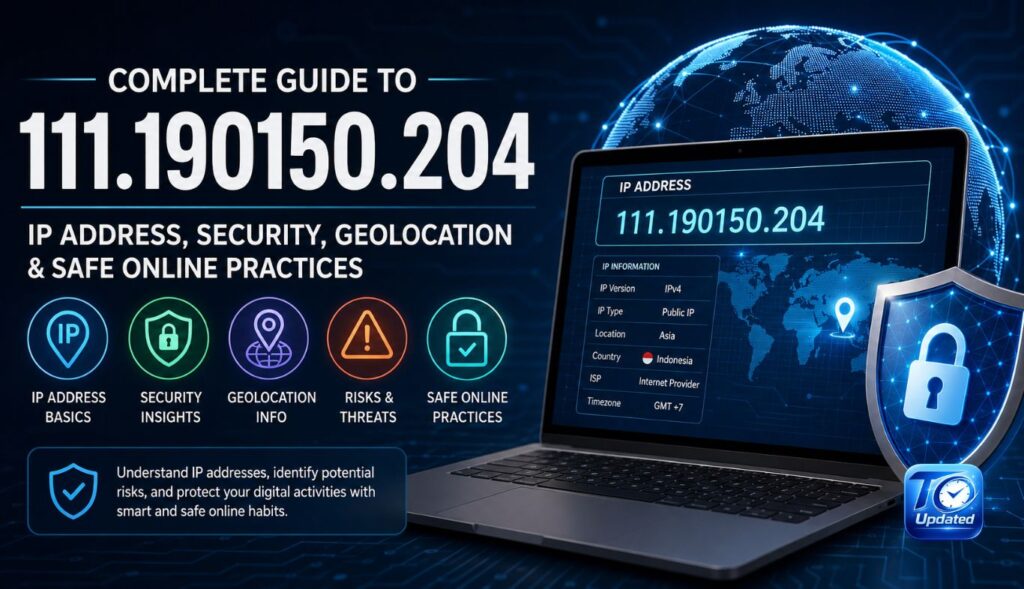

The internet runs on a system of unique numerical identifiers known as IP addresses. Whenever you browse a website, stream a video, send an email, or use an online application, an IP address helps devices communicate with one another. One address that may attract attention is 111.190150.204. Whether you discovered it in a server log, website analytics report, firewall notification, or network monitoring tool, understanding its purpose is essential before drawing any conclusions.
For internet users in Indonesia, cybersecurity awareness continues to grow as more businesses, schools, and individuals rely on digital services every day. Knowing how an IP address works can help users identify suspicious network activity, troubleshoot connection problems, and improve online privacy. Instead of assuming an address is dangerous or trustworthy, it is always better to analyze it using reliable networking principles.
This guide explains 111.190150.204 from a practical perspective. Rather than making unsupported claims about its owner or exact location, the article explores how IP addresses function, how network administrators investigate them, and what users should know when they encounter unfamiliar addresses.
By the end of this guide, you will understand the importance of IP addresses, the role of geolocation tools, security considerations, lookup methods, and best practices for protecting your online activities. Whether you are a casual internet user, a website owner, or an IT professional, the information below will help you make informed decisions.
Understanding 111.190150.204
The address 111.190150.204 appears to resemble an IPv4 address, but before analyzing it further, it is important to understand the formatting rules that define a valid IPv4 address. Every IPv4 address contains four numerical sections separated by periods. Each section, commonly called an octet, must contain a value ranging from zero to two hundred fifty-five.
When users encounter addresses in server logs, firewall reports, or website traffic records, typing mistakes occasionally occur. Missing periods or incorrect formatting can make an address appear unusual even though it may simply be a recording or transcription error. Therefore, the first step is always verifying that the address follows standard IPv4 syntax before attempting geolocation or security analysis.
Understanding formatting is especially important because many online lookup tools require accurate input. A small error can produce no results or display information about an entirely different address. Careful verification saves time and prevents incorrect conclusions during network troubleshooting.
For Indonesian businesses operating websites, validating IP addresses before blocking or allowing traffic is considered a best practice. It reduces the risk of accidentally restricting legitimate visitors while ensuring security measures remain effective.
What Is an IP Address?
An Internet Protocol address serves as the digital identity of a device connected to a network. Whether the device is a smartphone, laptop, server, security camera, or smart television, it communicates through an IP address whenever it exchanges information over the internet.
Every request made while browsing a website includes an IP address so that servers know where to send the requested information. Without these numerical identifiers, internet communication would not function efficiently.
Public IP addresses are assigned by internet service providers, while private IP addresses operate within local networks such as homes, schools, and offices. Public addresses enable communication across the internet, whereas private addresses manage communication between devices inside a local environment.

Understanding the distinction between public and private addresses helps users troubleshoot network issues, configure routers, and improve cybersecurity awareness.
How IPv4 Works
IPv4 remains the most widely recognized internet addressing system despite the gradual adoption of IPv6. It uses a thirty-two-bit addressing format divided into four numerical sections.
Each section contains values ranging from zero through two hundred fifty-five, producing billions of possible address combinations. Although IPv6 was introduced to overcome address shortages, IPv4 continues powering a significant portion of today’s internet infrastructure.
Businesses across Indonesia still depend heavily on IPv4 networking because many enterprise systems, hosting providers, and consumer internet connections continue supporting this protocol.
Is 111.190150.204 a Valid Public IP?
When evaluating 111.190150.204, one important observation is its formatting. Standard IPv4 addresses consist of exactly four octets separated by three periods, with every octet containing a value between zero and two hundred fifty-five.
In the written form 111.190150.204, the second section appears as 190150, which exceeds the maximum permitted value for an IPv4 octet. Because of this, the address as written does not conform to standard IPv4 formatting rules.
This often happens because of transcription mistakes, copied log entries, formatting errors, or missing punctuation. Before performing any WHOIS lookup, blacklist check, or geolocation search, users should verify whether an extra period is missing or whether one of the digits was entered incorrectly.
Correct formatting is the foundation of every successful IP investigation. Without it, lookup tools cannot accurately identify ownership, location, or network information.
How IP Addresses Are Assigned
Internet users rarely choose their own public IP addresses. Instead, internet service providers receive address allocations from regional internet registries responsible for managing global IP resources.
Once an ISP receives an allocation, it distributes addresses to residential customers, businesses, government agencies, and cloud hosting providers according to network requirements.
Some addresses remain static, meaning they rarely change, while others are dynamic and may change whenever the modem reconnects or after a specified lease period. Dynamic addressing is common for home internet connections because it simplifies address management and improves network efficiency.
Understanding how addresses are assigned helps explain why seeing an unfamiliar IP address does not automatically indicate malicious activity. It may simply belong to another customer using the same internet provider.
Why You Might Encounter 111.190150.204
Many people first notice an unfamiliar IP address while reviewing website analytics, checking firewall logs, monitoring cloud servers, or investigating failed login attempts. Others may discover it while using online networking tools or reviewing router activity.
Website administrators frequently examine incoming IP addresses to understand visitor traffic, identify unusual login attempts, or analyze suspicious behavior. Likewise, cybersecurity professionals monitor network logs to detect abnormal communication patterns that could indicate unauthorized access attempts.
However, identifying an unfamiliar IP address should always be followed by careful verification rather than immediate assumptions. Legitimate search engines, content delivery networks, corporate networks, and cloud services generate large volumes of IP-based traffic every day. Distinguishing normal activity from suspicious behavior requires accurate data and proper analysis.
How IP Lookup Services Work
When users encounter an unfamiliar address such as 111.190150.204, their first instinct is often to search for it using an IP lookup tool. These services gather publicly available information from internet registries, routing databases, and network records to provide general details about an address. Although lookup platforms are valuable for research, they do not reveal private personal information about the individual using an IP address.
A typical lookup report may include the autonomous system responsible for routing the address, the internet service provider, the country where the address is likely registered, and whether the address belongs to a hosting provider or residential network. Some tools also display the estimated time zone, organization name, and routing information. However, these details should always be considered approximate because network ownership and routing can change over time.
Before performing a lookup, users should verify that the IP address is written correctly. As explained earlier, 111.190150.204 appears to have an invalid IPv4 format because one segment exceeds the allowed numerical range. Correcting formatting mistakes is essential before expecting meaningful lookup results.
Understanding IP Geolocation
IP geolocation is frequently misunderstood. Many people believe an IP address can identify the precise physical location of a person, but this is rarely true. Instead, geolocation databases estimate a general location based on information provided by internet service providers and public routing records.
The reported location may represent a nearby city, a regional data center, or even the headquarters of the ISP rather than the user’s actual home or office. In some situations, cloud infrastructure routes traffic through different regions, making the displayed location even less precise.
For businesses in Indonesia, IP geolocation remains useful for delivering localized content, displaying the correct language, improving website performance through regional servers, and detecting unusual login attempts from unexpected countries. Even so, geolocation should never be treated as exact evidence of a user’s physical whereabouts.
Understanding these limitations helps website owners make better security decisions without relying on inaccurate assumptions.
Security Considerations When Investigating an IP Address
Cybersecurity begins with observation rather than immediate action. Discovering an unfamiliar address in a server log does not automatically indicate malicious behavior. Search engine crawlers, software update services, cloud providers, and monitoring platforms all generate legitimate network traffic.
The best approach is to evaluate the surrounding context. Administrators should examine timestamps, request frequency, requested resources, login attempts, and user behavior before deciding whether traffic is suspicious. Patterns often reveal more useful information than a single IP address alone.
If repeated failed login attempts originate from the same address, additional investigation may be justified. Likewise, unusually high request volumes could indicate automated bots or attempted abuse. However, blocking traffic solely because an address looks unfamiliar may unintentionally prevent legitimate visitors from accessing a website.
Security professionals generally recommend combining firewall logs, intrusion detection systems, web analytics, and authentication records to develop a complete understanding of network activity.
Common Reasons an IP Address Appears in Website Logs
Website owners often wonder why unfamiliar addresses suddenly appear in traffic reports. In reality, internet servers receive requests from many different sources every day. Search engines continuously crawl websites to update search indexes. Visitors access pages from different cities and countries. Automated services monitor uptime and website availability.
Content delivery networks may also communicate using their own infrastructure, resulting in addresses that do not belong directly to website visitors. Similarly, cloud hosting providers frequently route requests through distributed systems that generate multiple IP addresses.
As websites become more popular, traffic naturally becomes more diverse. Therefore, seeing an unfamiliar address such as 111.190150.204 should simply encourage verification rather than immediate concern.
The Difference Between Static and Dynamic IP Addresses
One important networking concept involves the distinction between static and dynamic IP addresses. A static address remains unchanged unless manually modified by the network administrator. Businesses, web servers, remote offices, and enterprise applications often rely on static addresses because consistent connectivity is essential.
Dynamic addresses, on the other hand, are temporarily assigned by internet service providers. Residential internet users commonly receive dynamic addresses that may change periodically depending on network configuration or modem reconnection.
This distinction explains why the same internet customer may appear under different public addresses over time. It also demonstrates why identifying an individual solely through an IP address is both unreliable and inaccurate.
Understanding this difference improves network troubleshooting and helps administrators interpret website analytics more effectively.
IPv4 and the Future of Internet Addressing
The rapid growth of internet-connected devices has significantly increased demand for IP addresses. Smartphones, laptops, smart televisions, IoT devices, industrial sensors, and cloud servers all require unique network identifiers.
Because IPv4 provides a limited number of addresses, the technology known as IPv6 was introduced to support an almost unlimited addressing capacity. IPv6 uses a much longer hexadecimal format capable of accommodating future internet expansion for decades to come.
Although IPv6 adoption continues to increase worldwide, IPv4 remains widely used across Indonesia and many other countries. Most internet service providers support both protocols simultaneously, allowing older systems and modern infrastructure to operate together without interruption.
Understanding this transition helps readers appreciate why IPv4 addresses continue appearing in website logs while newer IPv6 addresses gradually become more common.
Protecting Your Privacy Online
Online privacy extends beyond simply hiding an IP address. Responsible internet usage includes protecting personal information, securing online accounts, and maintaining safe browsing habits. Users should regularly update operating systems, browsers, and applications to reduce exposure to known vulnerabilities.
Strong passwords remain one of the most effective security measures. Combining unique passwords with multi-factor authentication significantly reduces the likelihood of unauthorized account access. Secure Wi-Fi networks also help prevent unwanted interception of internet traffic.
Many users choose to browse through reputable Virtual Private Networks when using public wireless networks. While VPNs improve privacy by encrypting internet traffic, they do not make users completely anonymous. Responsible browsing behavior remains essential regardless of the technology being used.
Organizations should also educate employees about phishing emails, suspicious downloads, and social engineering attacks because human error remains one of the most common cybersecurity risks.
Best Practices for Network Monitoring
Effective network monitoring involves continuous observation rather than occasional investigation. Businesses should regularly review firewall logs, authentication records, website analytics, and intrusion detection reports to identify unusual patterns before they become significant security incidents.
Automated alerts can notify administrators whenever repeated login failures, excessive traffic, or abnormal requests occur. Regular software updates further strengthen security by closing known vulnerabilities that attackers might otherwise exploit.
Routine security audits help organizations verify firewall configurations, user permissions, and network policies. By combining monitoring with proactive maintenance, businesses create a stronger defense against evolving cyber threats.
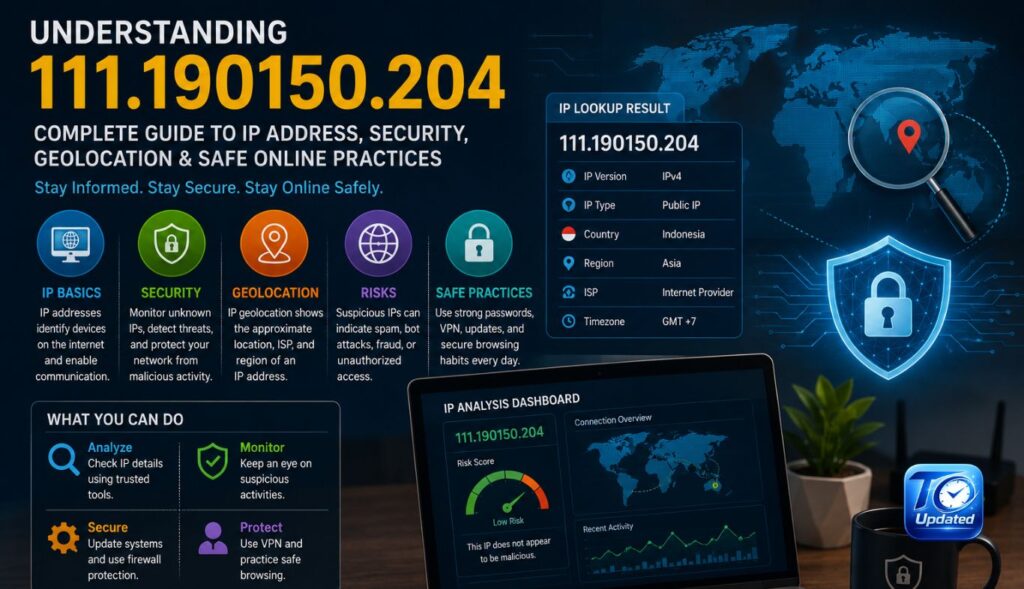
Whether investigating 111.190150.204 or any other unfamiliar address, careful analysis supported by accurate data is always more effective than assumptions based solely on numerical identifiers.
FAQ
What is 111.190150.204, and why might someone search for it?
Many people search for 111.190150.204 after noticing it in website analytics, server logs, firewall reports, or network monitoring tools. It is natural to become curious when an unfamiliar address appears in online activity. However, the address as written does not follow the standard IPv4 format because one section exceeds the maximum value allowed in an IPv4 octet. Before assuming anything about its origin or purpose, users should first verify whether the address contains a formatting error or a missing period. Correct formatting is essential for obtaining meaningful lookup results and understanding the address accurately.
Can an IP address reveal a person’s exact location?
An IP address cannot usually identify someone’s precise physical location. Instead, IP geolocation services provide an estimated region based on publicly available network information. In many situations, the reported city represents the internet service provider’s infrastructure or a nearby data center rather than the user’s home or office. This limitation is important for website owners, businesses, and cybersecurity professionals because geolocation should be treated as an approximation instead of exact evidence.
Is it dangerous if an unknown IP address appears in my server logs?
Not necessarily. Every website receives traffic from many different sources, including search engines, cloud services, monitoring platforms, content delivery networks, and genuine visitors. An unfamiliar address alone does not indicate malicious activity. Administrators should examine the complete context, including request frequency, accessed pages, login attempts, and timestamps, before determining whether further investigation is necessary. Careful analysis always produces better security decisions than reacting to isolated IP addresses.
How can I verify whether an IP address is valid?
The simplest method is to check its structure. A standard IPv4 address contains four numerical sections separated by periods, and each section must have a value between zero and two hundred fifty-five. If any segment falls outside this range, the address is considered invalid. Since 111.190150.204 contains a section that exceeds the acceptable value, it should be reviewed for possible formatting mistakes before being used in any lookup or security analysis.
Why do internet service providers change IP addresses?
Many residential internet connections use dynamic IP addressing, meaning the internet service provider temporarily assigns an address to the customer. The address may change after the modem reconnects or when the lease period expires. Dynamic addressing improves network efficiency and helps providers manage available resources. Businesses that require permanent accessibility often choose static IP addresses because those remain consistent over time and simplify remote access and server management.
Should I block an unfamiliar IP address immediately?
Blocking an address without proper investigation is generally not recommended. Many legitimate users, automated search engine crawlers, software update services, and cloud providers generate traffic from unfamiliar addresses every day. Instead of blocking immediately, administrators should review traffic patterns, examine security logs, and evaluate user behavior. If multiple indicators suggest abusive or suspicious activity, then applying firewall rules or additional security measures becomes a more informed decision.
What are the best ways to improve online security?
Improving cybersecurity involves several good habits working together rather than relying on a single solution. Keeping software updated, using strong and unique passwords, enabling multi-factor authentication, monitoring network logs, and avoiding suspicious downloads all contribute to better security. Individuals and businesses should also educate themselves about phishing attacks and regularly review account activity. These practical measures help reduce security risks regardless of which IP addresses appear in network traffic.
Conclusion
Understanding 111.190150.204 requires more than simply entering it into an online lookup tool. The first and most important step is verifying that the address follows the standard IPv4 format. Since the written version contains a numerical section that exceeds the accepted range, it is likely incomplete or incorrectly formatted. Correcting such errors is essential before attempting geolocation, ownership research, or security analysis.
For internet users in Indonesia and around the world, learning how IP addresses function provides valuable insight into modern networking. Whether reviewing website analytics, investigating firewall logs, or improving cybersecurity practices, knowledge of IP addressing helps users make informed decisions based on evidence instead of assumptions. Public and private IP addresses, dynamic and static assignments, geolocation databases, and security monitoring all play important roles in maintaining reliable internet communication.

Ultimately, 111.190150.204 serves as a useful reminder that accuracy matters in network administration. Always verify formatting, rely on trusted networking tools, and interpret lookup results carefully. By following these best practices, individuals and organizations can strengthen cybersecurity, troubleshoot network issues more effectively, and build a safer online environment. Whenever you encounter 111.190150.204 or any similar address in the future, approach the information with careful analysis, informed judgment, and a commitment to responsible digital security.